physical
2011
Klangfelder
×
Klangfelder (2011)
A reactive sound-installation at the "Humboldt Box", Berlin. Visitors can explore, compare and mix ethnic sounds by moving through the room. A projection onto the floor will guide the visitor in a playful way and uncover the origin of the different sounds.
×
2011
beyond
×
beyond (2011)
The digital illumination of a free running(swinging) stage setting.
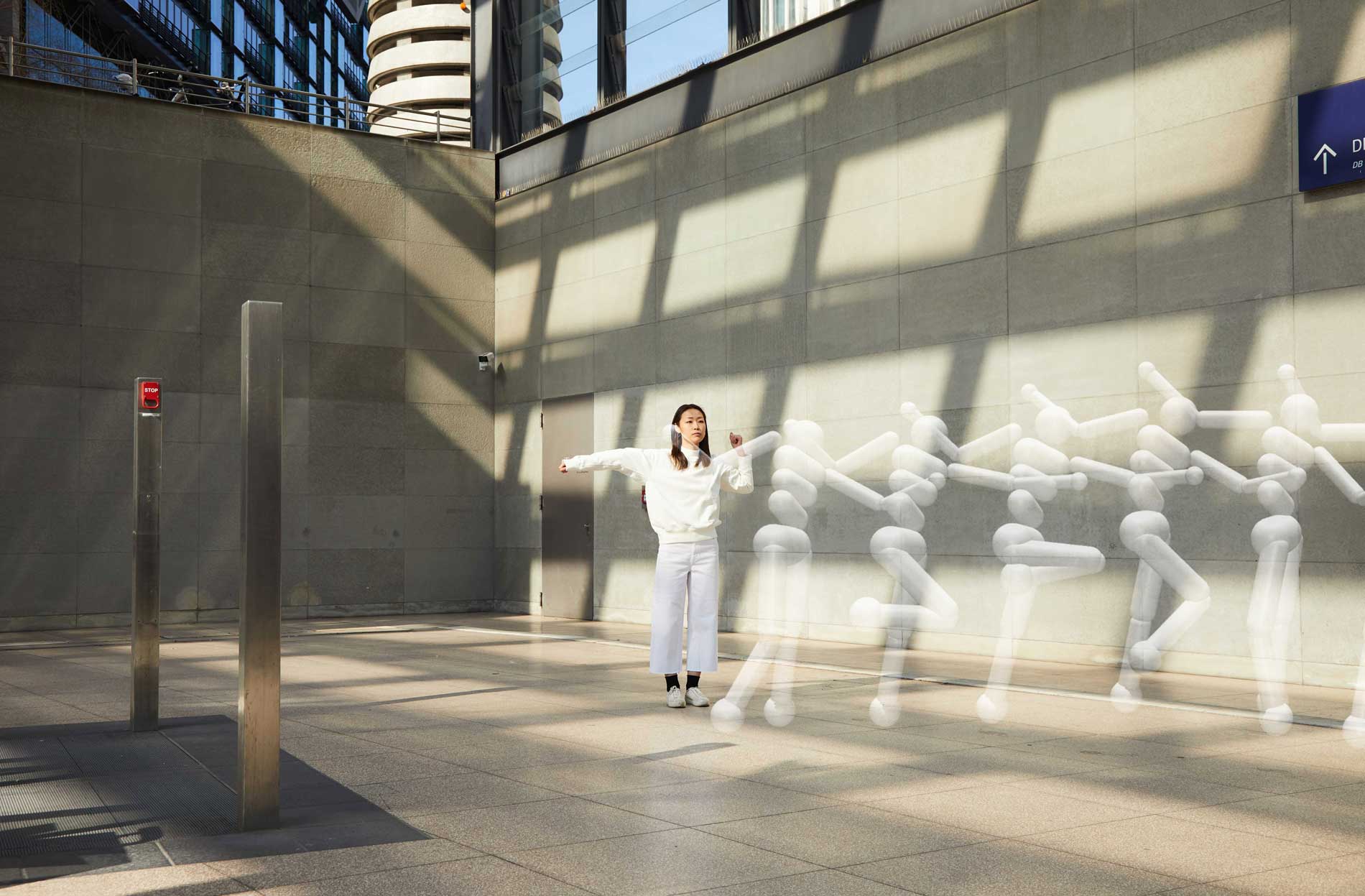
In the dance pice ‚"beyond episode II"‚ by Christina Thoma and Tanja Büchel, the dancers explore the behavior and reaction of a free running(swinging) stage. Every step or movement transfers energy into the stage and results in apparently unpredictable movements.
As my final thesis i developed a visual concept for a mostly projection based illumination of this performance, using generative graphics.
These graphics needed to be reactive to the movement of the stage and to the choreography, therefore i developed a technical system and framework using camera tracking and multi-head projection.

After developing the tools for such a task, i focused on creating visual concepts for each sequence of the performance.

test setup
test setup
components
×
2009
Telepoesie
×
Telepoesie (2009)
(all photos by Martin Diebel)
Telepoesie is a light installation on the top of the "Alte Museum Berlin". Visitors can enter little sentences, in a terminal in the Lustgarten in front of the museum, which will be directly displayed at the top of the museum.
roof top
Terminal to insert text
interface closeup
mounting the ligths (at the MediaPool workshop)
×
2008
mæve
×
mæve (2008)
The interactive installation mæve provides visual and tangible access to the social and intellectual networks behind architectural projects. The installation is part of the 11th International Architecture Exhibition of the Venice Biennale.
At the Biennale, mæve connects the entries of the Everyville student competition and puts them into the larger context of MACE content and metadata. By placing physical project cards on an interactive surface, users can explore the presented projects, embedded in an organic network of associated projects, people and media.

interaction:
The installation consists of an interactive surface and a large projection area. While users are interacting with the contents of the installation on the interactive surface, the network and the media files are displayed on the large projection. The ten winning projects from the Everyville student competition are represented as physical cards. If a card is placed on the interactive surface, a contextual space is opened around the project. Within this space, media files, related projects and keywords are visualized. When a second card is placed on the surface, the space turns into a network displaying similarities between the projects. In addition to the Everyville cards, the installation also contains inspirational projects from the MACE repositories. These projects are also represented by project cards and enable the visitors to connect the Everyville projects to MACE contents. Furthermore, as the interaction with the cards is not limited to the one person, entire groups and teams can explore the content together.
(text by http://portal.mace-project.eu/maeve)
×
2007
on the go
×
Thermal Information Display (2007)
(photo by Adam Danielsson)
The paper ‘A Thermal Information Display for Mobile Applications’ was published at the 9th international conference on Human computer interaction with mobile devices and services. It is available in the ACM International Conference Proceeding Series.
Paper Abstract: In this paper, we investigate possibilities and limitations of temperature change as a method for information display in mobile applications. While some widespread and well‑recognized haptic displays such as force‑feedback often trigger the user’s immediate attention, we will focus on ambient strategies for tactile information display, that is, the display of gradual state changes in the user’s periphery that do not unexpectedly interrupt her current tasks, but builds on the mind’s ability for subliminal perception of environmental change instead.
To this end, we present a series of prototypes of mobile devices that display ambient information by means of thermal change based on the thermo‑electric effect. In order to assess the expedience and feasibility of such a display, a series of user tests have been conducted with respect to both, the ability for thermal change recognition and a concrete application scenario for such a display.
Prototype setup for long-term user tests
×
2006
Rememorize
×
Rememorize (2006)
(photo by Björn Wahlström)
The main idea behind the concept is the old game of Memory where one needs to collect pairs of cards with the same picture on them. The player who collects the majority of the pairs wins. Re-Memorize has the same structure but exclueds the visual part in order to work with the sense of sound.
We live in a time with a constant overflow of visual communication. Everywhere we go pictures throw themselves opun us. In consequence our visual sense is very well trained.

Memory is by many regarded as a highly challenging game, but imagine the increasing level of difficulty when you need to memorize sounds instead of pictures. The game will naturally be suitable for people with low or no eyesight.
Re-Memorize will appeal to all everyone who likes playing games and competition no matter if one has perfect eyesight or is completely blind. It also offers a valuable alternative to other games that are often connected to visual communication.

Interaction walkthrough:
When Re-Memorize is turned on you will first hear a welcome melody, then you just shuffle the cards and place them out. The first player starts buy turning the switch of any of the 64 gamesquares. The game will tell the position ( Ex B-7 ) and then play the melody connected to that card. When the melody has played, the first player can flip a second switch, and again the game will tell the position of that card and play a melody. If the same sound is played on both the first and the second flip of the switch a pair is found and a small congratulation song will be played. The player will pull the card from the gamesquares and keep them as his pair. After finding a pair the player will get a new try. If two different melodies are played the player will get a failure sound. Then the player needs to flip the switches back and the next player gets his try.

This will go on until all cards have been taken. The player who collected most of the pairs wins and both the winner and the loser/losers can listen to the celebration song.
(photo by Björn Wahlström)
×
visual
2010
Design landscape
×
Design landscape (2010)
The goal of this project is to create a printed map giving an overview of the approximately 1500 design agencies based in berlin. Focusing on the different branches the agencies are working in, as well as the amount of employees and currently job and internship offers.
Basically the map looks like a city map displaying each agency in form of a house that holds all relevant parameters. This project is based on the database of the ‘Designszene Berlin’ website by the International Design Centre Berlin, who is a partner for this project. Every agency in this database is tagged with up to six different design branches. The layout of the house is dominated by these tags. All agencies working in the same design branch are grouped into boroughs; i.e., all agencies working only in Industrial Design and in Communication Design are grouped in one borough. The six boroughs including the agency who are tagged only for one branch are laid out clockwise on the outside of the map. All other boroughs, having more then on tag, are laid out between these six main boroughs depending on the tags they include; i.e., the borough having the tag Industrial Design and Communication Design will be placed between the Industrial Design borough and the Communication Design borough.
×
2009
Rakete bee bee
×
Rakete bee bee (2009)
Rakete bee bee is a project trying to explore different ways of displaying the score of Kurt Schwitters ‘Ursonate’ by applying Information ( extracted of a ‘Ursonate’ recording ) on the written text.
The ‘Ursonate’ is a so called speech opera written and performed by Kurt Schwitters. Different versions of the ‘Ursonate’ are available, all created between 1923 and 1932. In 1932 Kurt Schwitters published the score in a design by Jan Tschichold. « Different artist used this score for their own interpretation and so several recordings of the Ursonate appeared over time.

The base for this project is the score as well as a recoding made by Salome Kammer in 2005.

At first the recording was analysed and evaluated by processing applications. As a result a data set was created, that includes the length of the words and pauses, as well as the amplitude of different frequencies. This data set is now applied onto the text through using javascript scripts in Adobe Indesign.

The aim of this project is to find a way to merge the characteristics ( metadata ) of the spoken word into the written word, as well as to find a way to break out of the strict rules and reduce additional devices that are needed to explain the score to the reader/singer.
one of five final prints
process snippet
process snippet
snippet snippet
×
2009
Lights!Director
×
Lights!Director (2009)
The primarily attempt of the multi-touch application Light!Director is to allow directors and designers a simple and intuitive device for creating a light concept for their production.
Intuitive and easy‑to‑learn gestures allow the user to create indiviudal and experimental light concepts without being limited by the need for expert knowledge or the need to understand the technichal components used for light engineering. The user can simply draw light sources and illuminated areas on the virtual stage, add attributes, browse through color settings and compose several lights to presets and cues.
Light!Director will enable the director or designer to bring his ideas on stage with the help of additional tools like a 3D life preview. This application will also improve the communication between technical stuff and director by taking the technical limitations of the stage into consideration and providing technical setup plans for the technical crew.
×
2006
Out of the Blue
×
Out of the Blue (2006)
>>out of the blue<< functions as my online portfolio by gathering together information about me and my work from the internet. I did not edit the displayed content (found links) used in this application, but I may have been involved in creating the content you find while following the links.
This Java Applet does several Google search requests with previously determined topics (for example >k3<, or >fh-potsdam< in combination with my name). A new Google search request will be initiated every time you start the application or press the redraw button, so you will always get fresh results.
With this applet, I am able to find and display my own digital footprint. Information about every one of us is readily available on the internet. Photos are tagged with our names, we create user profiles, people quote our existing work in their own projects (as is common in open source projects) or write about us in their blogs. We are all part of and creators of the >>long tail<<.
>>out of the blue<< allows me to gather this information and display it in an alternative way, as a visualization of the relationships between different hits and topics.
×
2007
850 Jahre
×
850 Jahre Mark Brandenburg (2007)
In summer 2007, six design students at the University of Applied Science Potsdam created an exhibition for the 850th years anniversary of the Mark Brandenburg, on the exhibition ground of Schaufenster in Potsdam. The hole project was done in just 52 days. Under the supervision of Prof. Detlef Saalfeld and Cora Gebauer and under the contend management of Gundula Christl, archaeologist of the city Potsdam. The exhibition was also on display at the archaeologic museum Brandenburg in december 2007.
×
lighting
2011
The Precision of …
×
The Precision of Freedom (2011)
(photos Iskender Kökce)
The Precision of Freedom is Banality Dreams newest production. A theater performance with seven actors focusing on the phenomenon of freedom in the modern western world.
The Precision of Freedom investigates the experience of freedom placing it in opposition to freedom as concept or ideal. In this way we distinguish between freedom on one hand as a collective feeling of “living in a world of boundless possibilities”, with all its stereotypes and symbols, and on the other hand freedom as a deep individual feeling, unique and elusive. And where and how can we experience it, if all kind of things are displayed and sold to us as freedom, but very few of these things really give us a personal experience of it?
(text by banality dreams)
(photos Iskender Kökce)
×
2009
>The Cowboy, …
×
The Cowboy, the Princess and the Chicken (2009)
(photos by Boris van Hoof)
There is hardly anything that doesn’t already exist. Ranging from questions such as the way we dress, put make-up on, nourish ourselves, lead friendships, meet somebody or do it for the first time, to questions about how we provide for our offspring or how we might like to die. For every aspect of life, there already exist countless completed, deliberated, experienced concepts, archetypes and models. These can be found in glossy magazines, films, books, newspapers and photos, even discussed in guidebooks, blogs, forums and TV broadcastings. To live means to choose and to create one’s own variation out of the variety of possibilities. ‘Have it your way!’ is how a successful fast food chain so simply formulates.
In the new work of Banality Dreams, a cowboy, a princess and a chicken encounter each other in the here and now and forming from the outset, a bizarre combination crossing the unexpected paths of romanticism, family planning and friendship in the 21st century. In this way The Cowboy, the Princess and the Chicken takes into focus the fragile openness and the unpredictable abyss of inter-human encounters in the modern world, and thereby dives into the everyday schizophrenia of dreams and objectivity, reality and fiction. The work is based on the desire to live out the ideals and life expectations in the banality and unintenionality of everyday situations, its absurd comic, its profound tragedy and brutality. The première takes place within the framework of No Limits, Berlin.
(text by banality-dreams)
×
2009
Natural fiction …
×
Natural fiction circus (2009)
(photos by Marcel Morschhauser, Kleon Medugorac)
Natural fiction circus has been a multimedia performance by Banality Dreams, featuring twelve citicens of the Vidaarasen camphill (Norway). On three evenings, in may 2009, we showed the work of a six week artistical dialogue between them and us, an international group of artists working in the fields of performance, visual arts and music.
Come and dive into an unpredictable multi-media theatre adventure, starring a group of people that have plenty to say, and they will say it in a way that you have never experienced before!

Banality Dreams, an international group of artist, teams up with a local group of disabled actors for an innovative art project to be developed in Vidaråsen, close to Andebu in Vestfold.
The Berlin-based group Banality Dreams is an award-winning alliance of artists who made it a sport never to do the same thing twice, leaving a trail of peculiar and controversial projects. They usually provocate strong reactions from their audience, and the group of passionate fans is growing steadily.

The current project has already been invited to the important theatre festival ‚No-Limits‘ in Berlin, and the group of actors is more than ready to shake the world of established theatre.

With a great portion of creativity and humor they are going to make their own very special statement.
(text by banality-dreams)
(photos by Marcel Morschhauser, Kleon Medugorac)
×
teaching
2011
Arduino / MIDI
×
Das singende, klingende Bäumchen (2011)
A one-week Arduino workshop about abstract musical instruments and controllers. Using Arduino as interface to common sound-synthesizer via the MIDI-protocol. This workshop took place at the HfG Schwaebisch Gmuend.
×
2011
Tangible Data
×
Tangible Data / MultiTouch-Table (2011)
A one term course about interactive surfaces and multitouch applications with the aim to develop a DIY interactive table for the new media lab at KHB-Weißensee.
inside the table
×
2011
IUAV Venice
×
prototyping workshop (2011)
Two-week workshop for the interaction design master program at the IUAV (University of Venice). During these two weeks we supported the students to transfer their concepts into physical prototypes, supervising their project management in order to help them to set up functioning prototypes within the given timeframe.
final presentation
final presentation
×
2010
arduino / skype
×
you got a message! (2010)
A one-week workshop at the HfG Schwaebisch Gmuend, about Arduino and skype. Exploring alternative input and output devices, beyond mouse and keyboard and furthermore investi-
gating new ways of interaction and communication, using the possibility of the physical space.
first scribbles
×
2009
100 Jahre HfG
×
100 Jahre HfG-Gmuend (2009)
(photos by Mark Lukas, Marcel Müller)
During the media facade project at the HfG, i supervised the students in the process of planning and developing a framework to control the setup of two projectors, two laser and a sound system. I also had been in charge of the production flow, event management and the technical implementation.
The Jubilee Year 2009 at the HfG ends with a impressive illumination of the facade to celebrate one hundred years of Martin Elsaesser's building. Communication Design students in fourth semester cooperated with Interaction Design students to make the listed building shine.

The project was based ob a five-day workshop that took place in November 2008 and used vvvv programming language to develop concepts for the large area facade animation. There followed almost half a year's organization, concept work, programming, and technical translation into real illumination. The actual animation was achieved using several different programs – Cinema 4D, Flash, After Effects, ScreenFlow und Premiere – but mainly with vvvv.
(text by FORMAT (2009))
test setup (photos by Mark Lukas, Marcel Müller)
setting up the laser(photos by Mark Lukas, Marcel Müller)
the hole setup (2x projector, 2x laser, 1x soundsystem) was controlled via vvvv (photos by Mark Lukas, Marcel Müller)
(photos by Mark Lukas, Marcel Müller)
FOH (photos by Mark Lukas, Marcel Müller)
manipulating the facade using a wacom board (photos by Mark Lukas, Marcel Müller)
interactive projection(photos by Mark Lukas, Marcel Müller)
×
| about
born 1982 in Berlin – 2003 starting his studies
of communication design at FH-Potsdam – 2
terms studies of interaction design at k3 (malmö högskola) 2005/06 – since 2006 working with
installations and physical prototyping – 2007/08
internship at Local Project LLC (New York
City) – since 2008 working as a light designer for different company's and productions – 2009
urban intervention class at the Prasons school
of Design, New York – 2009/10 running the
medialab at HfG Schwäbisch Gmünd – 2011
graduated from FH-Potsdam – 2012 he does love that girl